Fourth Trimester Health
Defining a sensor ecosystem that bridges the postpartum care gap.
53% of pregnancy-related deaths occur during the postpartum period.* This is how a full sensor stack, artificial intelligence, and a telehealth system can address that.
Role(s)
Research Lead, Team Lead, Service Designer
Team
30+ Multidisciplinary Crew
5 Cloud Engineers,
4 Environmental Engineers,
4 Wearable Engineers,
5 Software Engineers,
6 AI/ML Engineers,
10 HCI Specialists
Client
99P Labs
Honda’s Innovation Research Lab
Duration
4 Months
Jan 2025 – Apr 2025
TLDR
Performed market research to identify project scope. Defined product functionality in tandem with engineers. Identified the riskiest assumptions for product adoption and applied the appropriate methodology to resolve uncertainty.
*“Four in 5 pregnancy-related deaths in the U.S. are preventable”, CDC Study, 2022
Project Overview
The Challenge
99P Labs tasked our team with creating a product with clear parameters.
[1] Use Sensors.
Environmental and wearable sensors needed to be a fundamental component of the final product.
[2] Leverage AI/ML.
Specifically, the product needed to create a digital twin of the user using sensor-collected data.
[3] Focus on Health.
The purpose of the digital twin was to provide personalized insights to improve the user’s wellbeing.
Brainstorming a Use Case
We had free rein to determine the product's focus. During initial brainstorming sessions, a suggestion arose to focus on outpatient care. However, this was still a vast problem space.
With my passion for women’s health, I realized the potential of focusing on the postpartum period
Discovering a Market Gap
There was a clear care gap between pregnancy and the postpartum period, along with ample potential for a meaningful tech intervention.
A pressing issue. Maternal mortality and morbidity are disproportionately high in the United States, demonstrating a need for improved and enhanced postpartum care.*
A need for health monitoring. 80%—this is the amount of pregnancy-related deaths that are preventable. A system that could proactively detect serious health complications before they escalate would be a game-changer.**
Clear market opportunity exposed by the limits of existing solutions. Current health wearables, such as the Apple Watch and Oura ring, are limited in scope and lack functionality appropriate for the postpartum period. Specifically, they do not monitor for blood pressure, a biometric that heavily correlates with many of the health complications that arise during this period.
Presenting Our Vision
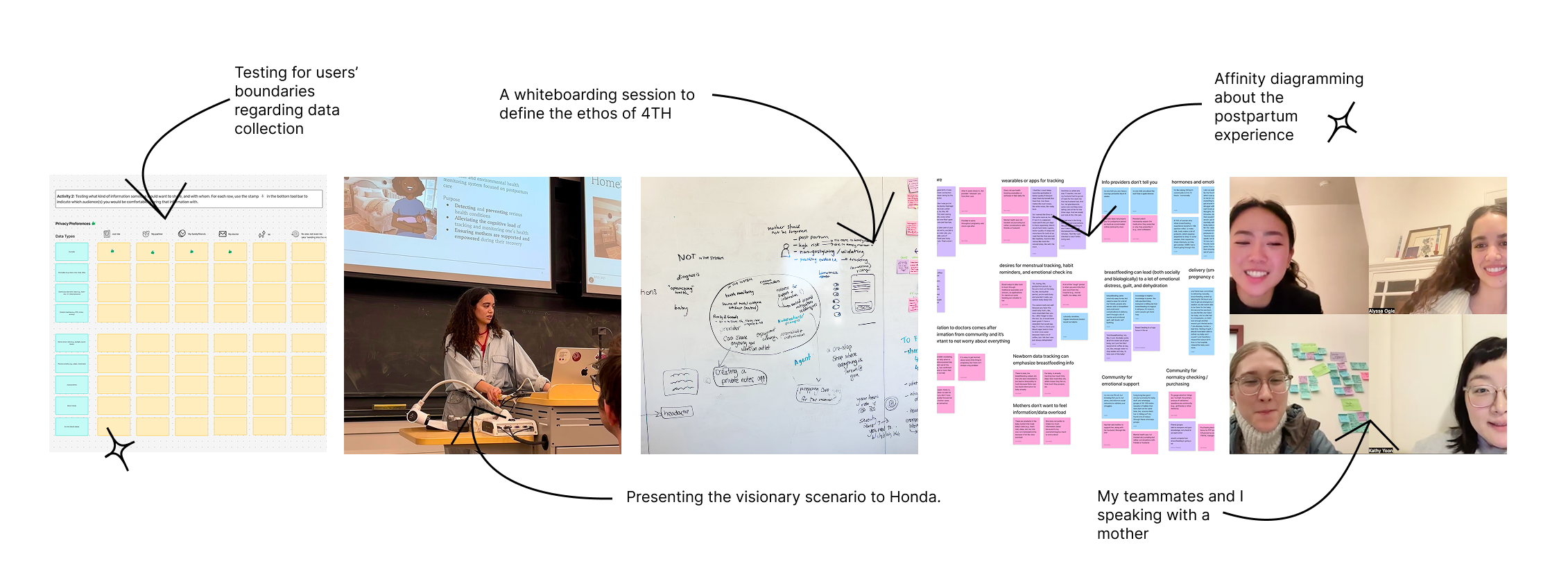
Building on the desk research I compiled, the HCI team and I created a presentation on why the postpartum period should be the project focus. Our pitch was selected!
*Trends in maternal mortality 2000 to 2020, WHO/ UNICEF / UNFPA / World Bank Group / UNDESA/Population Division, 2023
**”Preventing Pregnancy-Related Deaths”, CDC Study, 2024
The Solution
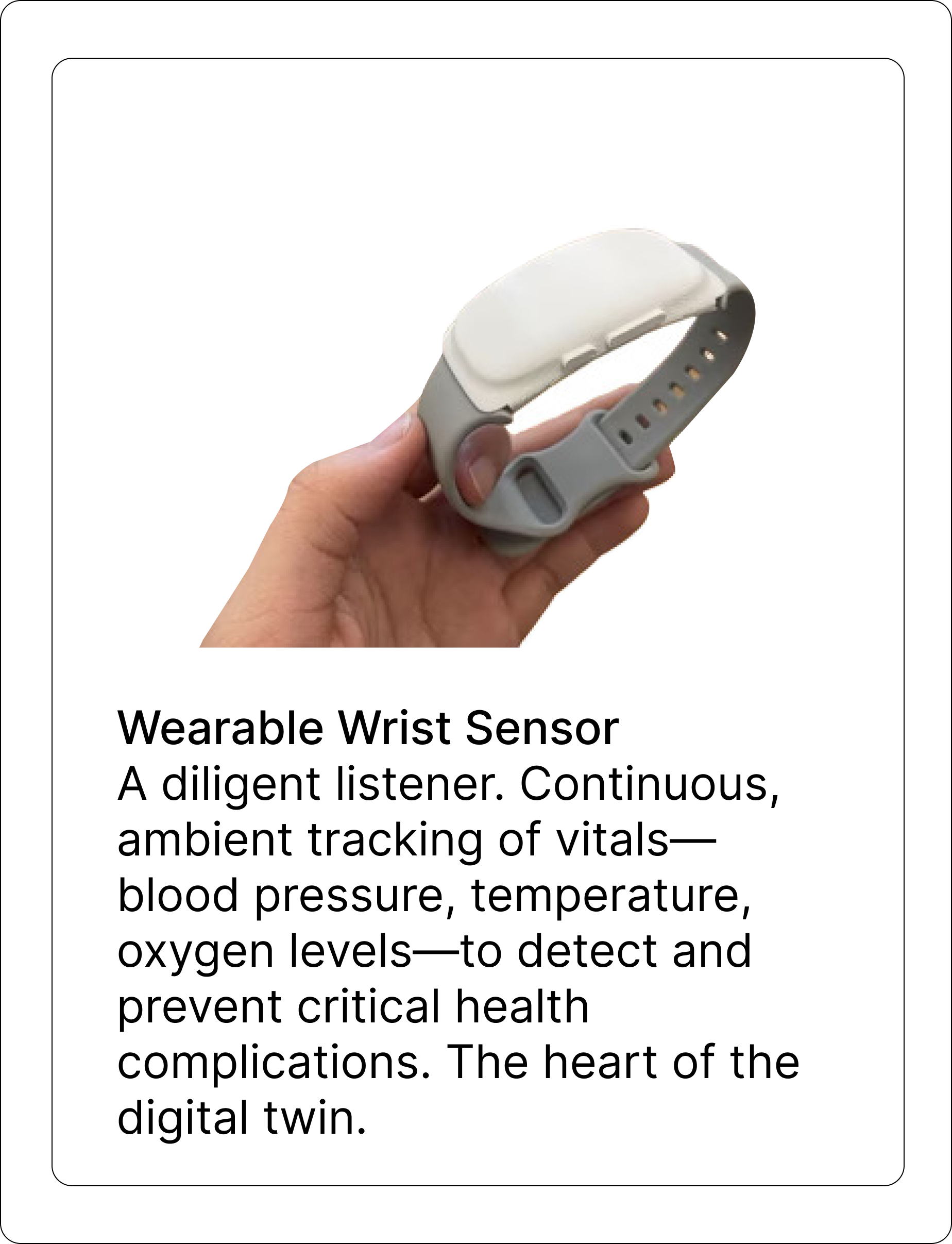
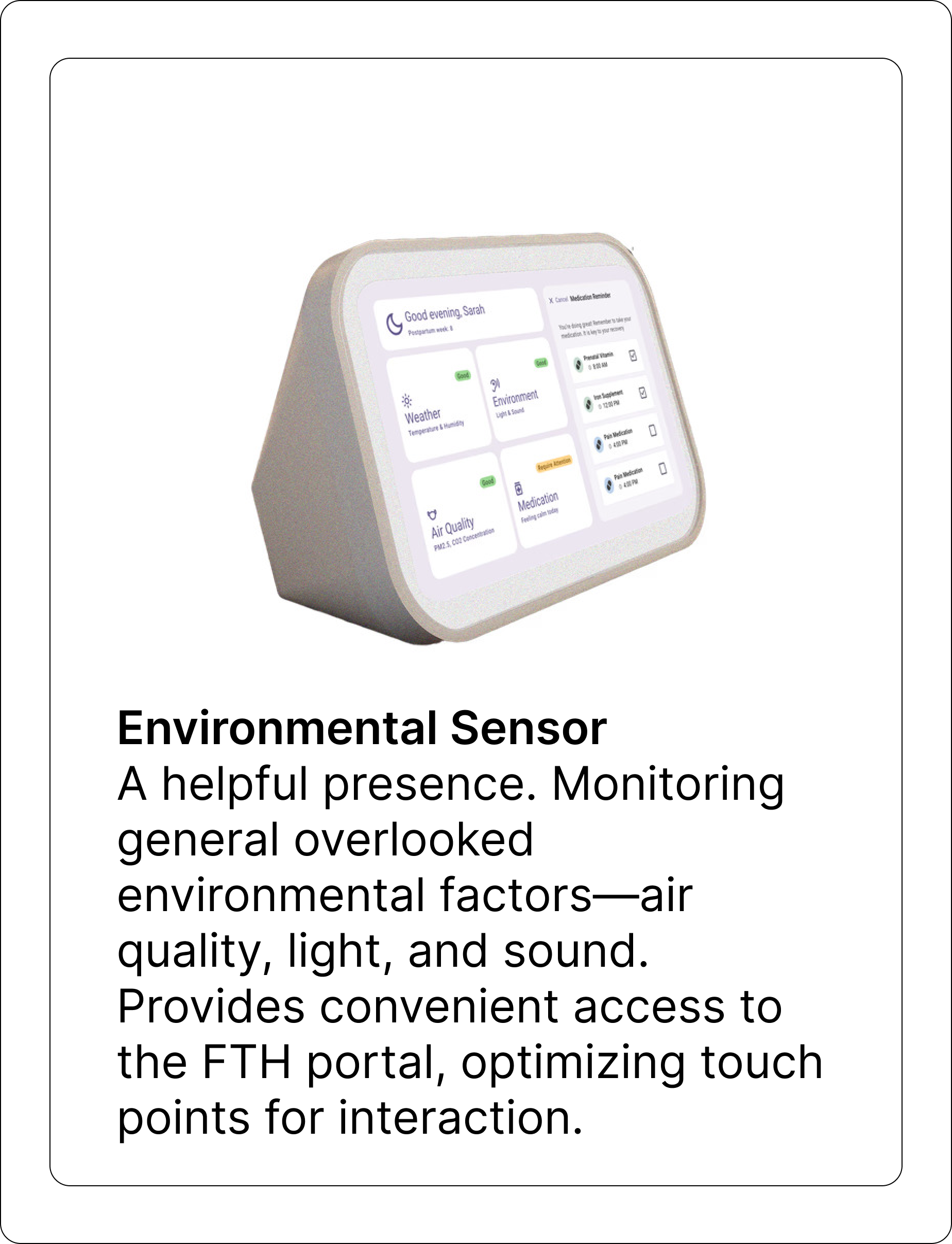
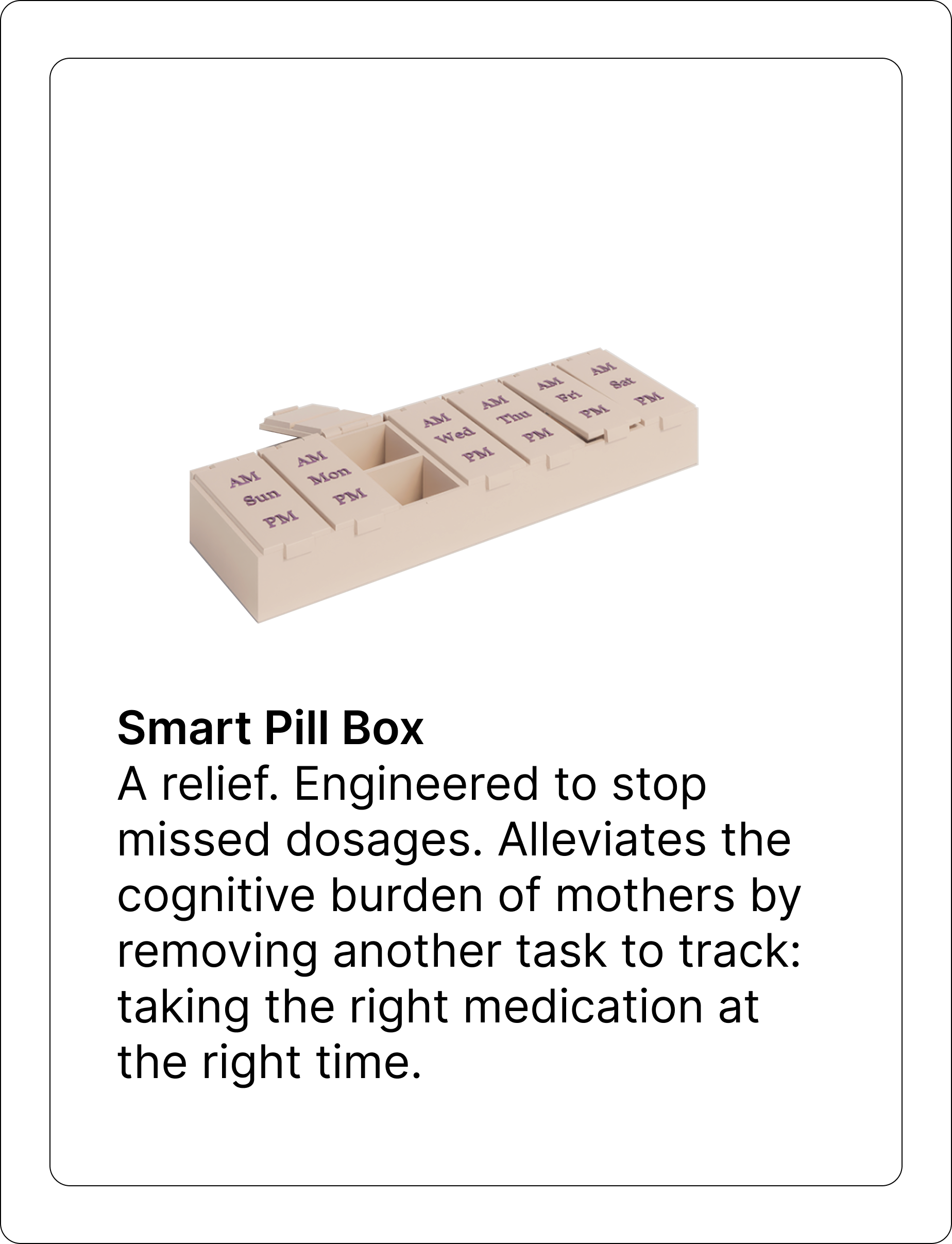
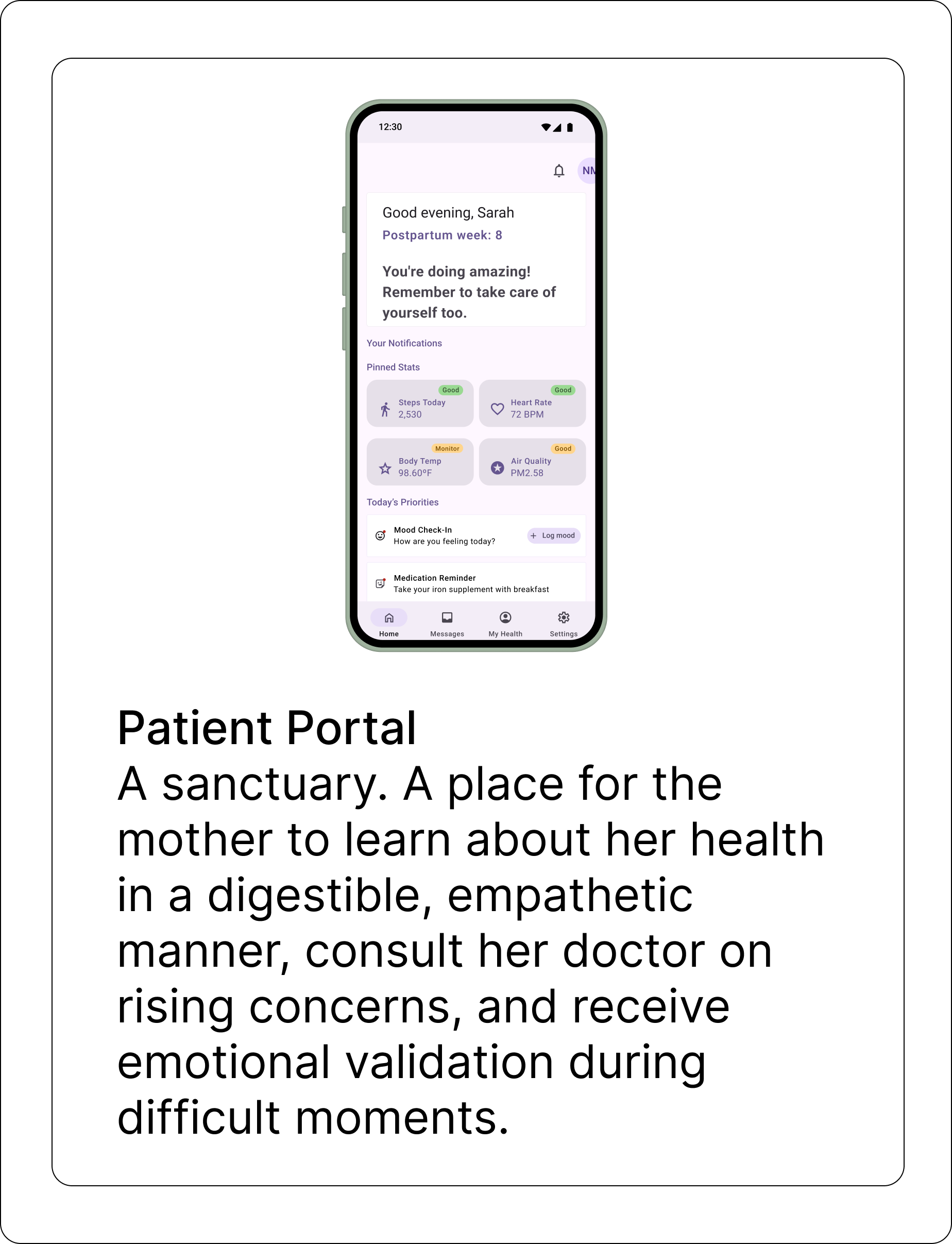
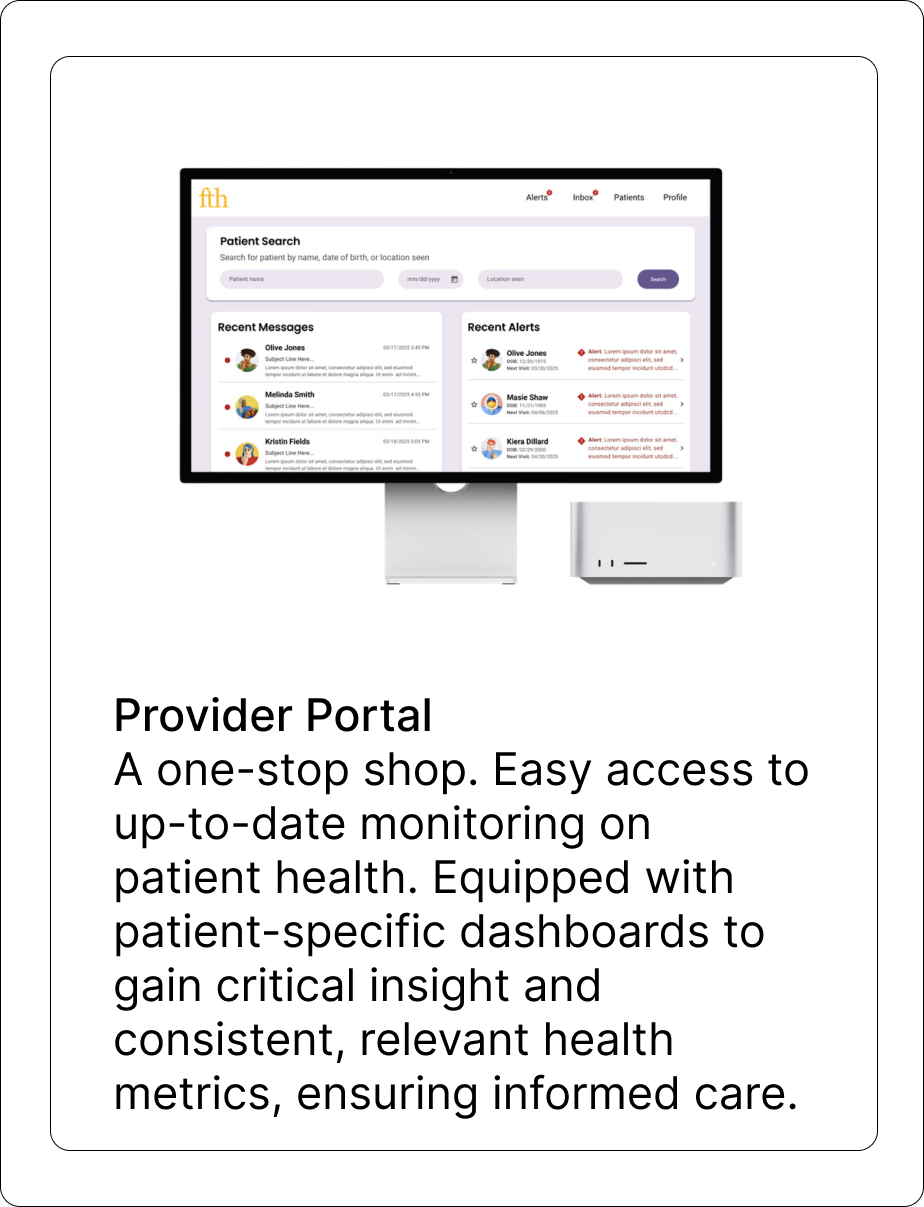
Fourth Trimester Health is a sensor ecosystem comprised of five main components: a wearable wrist sensor, an environmental sensor, a smart pill box, a patient portal, and a provider portal. A system where each individual component becomes greater than the sum of its parts. Designed with empathy and intention to equip doctors to provide the best care possible and to empower mothers as they navigate one of the most physically and emotionally difficult moments of their lives.
The Research Process
Product Definition
Determining the actual features and requirements of our product.
Objective
Identify the biometrics that our sensor system should collect.
Attain a comprehensive understanding of the postpartum period—the health complications, hormonal impact, —and the current solutions for monitoring the postpartum period.
Methodology
Desk Research, consisting of 10+ sources that included academic articles from medical and biotech journals, news articles, and government reports by the CDC and NIH.
Uncovering Unmet Needs and Pain Points
Connecting with key user groups, mothers and healthcare providers.
Objective
Understand the lived experience of the postpartum period
Validate product-market fit for both core users
Identify unmet needs not addressed by existing tools
Methodology
3 In-Depth Interviews with ObGyn practitioners
1 In-Depth Interview with a Doula
5 In-Depth Interviews with Mothers
Impact
Identified a three-part notification framework: acknowledge the difficulty → validate it's real → end with a graceful acknowledgment of posivitity
Defined a framework for data collection that equipped the model to have a robust source of data without sacrificing user trust.
Elevated dashboard design of the provider portal by providing constructive recommendations based on collected feedback.
Uncovered Moments that Guided Me
"When I see these depressing facts — it just feels like a reminder that your life is really depressing and stressful right now. Something positive at the end of each of these boxes — that can be helpful to the mother."
— SK, 35-year-old mother of a 6-month-old, during the notification matrix activity.
"I want the doctor to continuously monitor my health — so that I can stay healthy without me being the only one knowing my condition."
— TW, 33-year-old mother of a 9-month-old, during the privacy matrix activity.
“[I] prefer trend and not mean. A fast heart, even brief, may represent a serious medical condition which would be lost in the mean.”
— Dr. Fairbanks, Ob-Gyn, in response to which provider dashboard he preferred.
My Impact and Findings
Co-produced the functional requirements for Fourth Trimester Health
Designed a product highly attuned to the postpartum period without sacrificing technical feasibility. Collaborated with the engineering teams on defining the type of sensors to incorporate and the biometrics for collection.
Uncovered Moments that Guided Me
“Because when I was pregnant, it was my health and the baby's health. But then, once the baby's out... it's just the baby itself and nothing about me, nothing about my health.”
— KY, 34-year-old mother of a 2-year-old
""I just took the questionnaires as just standard checkup questionnaires that really didn't care about my well-being. I just checked — okay, I feel like I am doing all right, so I'll just check, hey, I'm doing okay, like out of one to ten, I'll just answer like all fives. So I feel like I wasn't being totally honest back then."
— AP, 39-year-old mother of a 3-year-old and 9-month-old.
"The three main things are going to be mental health, physical health, and health of the baby.The mom trying to juggle all that stuff and feeling like she's on her own — even if she does live in a home with a husband and kids — the woman still feels responsible for all of it."
— Dr. Scott, Ob-Gyn
Iteration and Evolution
Creating a product that anticipates needs and augments capabilities.
Objective
Determine suitable tone and content for emotional support notifications.
Understand mother’s perceptions, boundaries, and expectations for data collection
Iterate upon the provider portal to ensure
Methodology
Notification matrix activity with 4 mothers — placing 30+ messages on a tame/crazy × like/dislike grid
Privacy matrix activity with 4 mothers — sorting data types by who they'd share them with
Usability Testing with 3 clinicians.
My Impact and Findings
Surfaced multiple root issues within current care systems, underscoring a clear need for FTH from both practitioners' and mothers' perspectives.
Discovered the inefficiency of current health monitoring processes: being analog. An approach that compromises data collection integrity and adds unnecessary labor for mothers.
Revealed a systemic burden on clinicians: without passive monitoring, providers dedicate significant time to manual patient reminders.
Found a severe flaw in current methods for emotion capture: their hollow and impersonal nature prevents genuine reflection.
Reflection
Advocate for what you believe in. The process for defining features was not always seamless. Sometimes the engineers were reluctant to add a feature that I truly believed in. Striking that balance between being innovative and overambitious requires a little push, and knowing what battles to fight.
Really consider all of your stakeholders. If I had more time, I would have loved to speak with partners. Partners are a vital component of maintaining and monitoring the health of new mothers. Learning how to support them in this system would have facilitated more support for mothers.
Being a leader requires having a strong vision not all of the answers. At first, I did not feel qualified to be a leader within this project because I was not technically strong. However, even with this gap, my conviction and passion for this project gave me two equally strong assets: the ability to maintain momentum and provide direction.
Focus on the core functionality. While building this product, it was easy to get carried away thinking about all the potential features and qualities Fourth Trimester Health could have. Creativity and imagination were boundless, but time and resources were not. Ensuring the need to focus in on what truly matters.